A Duck Score White Paper
February 2025
Authors: Mark Dando & Emma Mulqueeny OBE
Executive Summary
Organisations face a critical challenge: whilst investment in workplace mental health programmes continues to rise, mental health challenges now cost the UK economy £53-56 billion annually through absenteeism, presenteeism and staff turnover – a 25% increase since 2019. Employee Assistance Programs (EAP’s), which serve over 13 million people across 80,000 UK and Irish organisations, are often the cornerstone of workplace mental health support. However, our comprehensive study of over 500 professionals across the UK, US, and Europe reveals that only 18% of organisations are rated as having “Excellent” mental health support by their employees – highlighting a critical disconnect between provision and effectiveness. Research suggests those most in need of support are often the least likely to seek it, creating a concerning gap in mental health provision.
Our research shows that trust and privacy concerns manifest differently across organisational hierarchies:
- Selective Disclosure: Approximately 65% of respondents would only share mental health challenges with select trusted colleagues or HR/wellness staff
- Universal Privacy Requirements: Across all seniority levels, privacy control and career protection emerge as non-negotiable requirements
- Role-Based Variations: Senior leaders show higher comfort with disclosure, but still emphasize the need for bounded sharing and privacy guarantees
With one in eight work days lost due to mental health-related absence, and rising presenteeism costing UK businesses significantly more, addressing trust barriers is both a moral and financial imperative. Our research reveals three critical trust enablers that organisations must address:
- Granular Privacy Control: The ability to selectively share information emerged as the top requirement across all roles
- Career Protection: Clear separation from performance reviews and professional development processes
- Evidence of Impact: Employees need transparent demonstration of how shared information improves support systems
This white paper presents a new framework for building trust-first mental health initiatives that employees will actually use, based on insights from individuals across organisational hierarchies – from individual contributors to senior management. We provide actionable insights for leaders to transform their approach to workplace mental health support, moving from broad, one-size-fits-all programmes to trust-enabled systems that drive genuine engagement and measurable business impact.
The Current Landscape
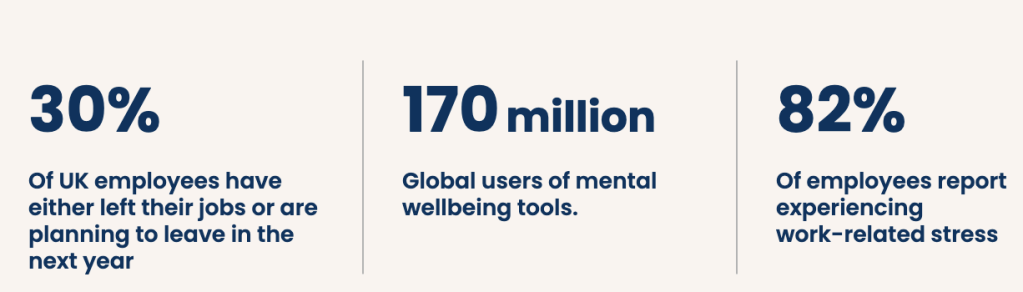
Deloitte’s 2024 Mental Health Report reveals that nearly 30% of UK employees have either left their jobs or are planning to leave in the next year, with mental health concerns driving almost 40% of turnover costs. Despite substantial investments, current approaches are delivering diminishing returns, with presenteeism remaining the largest challenge and staff turnover rates climbing.
This organisational challenge exists against a backdrop of growing personal investment in mental wellbeing. Employees are increasingly taking proactive steps to manage their mental health, evidenced by the explosive growth of mental wellness and mindfulness apps. Platforms like Calm and Headspace now serve over 170 million users globally, with individuals willing to invest their own time and money in mental wellbeing tools. This personal commitment to mental health makes the organisational trust gap even more striking – while people are actively seeking support through private channels, they remain hesitant to engage with workplace mental health provisions.
The current approach to workplace mental health typically centres on service availability and basic utilisation metrics. While organisations track service access and satisfaction scores, this surface-level analysis misses crucial opportunities for deeper insights and proactive intervention. According to Deloitte’s research, proactive interventions consistently deliver better outcomes and higher returns on investment than reactive approaches.
Organisations that successfully collect trusted mental health data gain access to critical insights that extend far beyond individual wellbeing. These insights can inform change readiness assessments, helping leaders understand their teams’ capacity for transformation. For example, as organisations navigate the implementation of AI into current business processes, understanding employee resilience and adaptability becomes critical to success. Early warning signals about resource pressure points and team stress levels can help leaders time and pace such significant operational changes effectively. This data-driven approach to transformation is particularly crucial given that 82% of employees report experiencing work-related stress, with the majority citing the need for better support during periods of organisational change.
Understanding Trust Barriers
The challenge isn’t just about providing mental health support—it’s about creating an environment where employees feel safe accessing it. Traditional approaches to workplace mental health often fail to recognize how trust dynamics vary across different organisational levels and contexts.
Senior leaders, while often advocating for mental health support, face unique challenges around vulnerability and information control. Our data shows that while they may be more comfortable discussing mental health in principle, they are particularly conscious of how their disclosures might impact their leadership authority. Middle managers find themselves in an especially complex position, needing to both support their teams’ mental health while managing their own challenges. Individual contributors, meanwhile, express the strongest concerns about how mental health disclosures might affect their career trajectories.
The impact of these trust barriers extends beyond individual wellbeing to affect critical business decisions. Without reliable mental health data, organisations struggle to accurately assess team capacity for change, identify optimal timing for major initiatives, or predict potential burnout points.
The Broader Impact of Trust
While our focus is on mental health support, building trust architecture has far-reaching implications for organisational performance. Harvard Business Review research demonstrates that high-trust organisations achieve remarkable advantages over their peers, including 76% more engagement, 50% more productivity, and 40% less burnout. Trust becomes the foundation upon which high-performing teams are built, enabling more effective collaboration, increased innovation, and greater resilience during periods of change.
These benefits create a virtuous cycle – as teams experience the positive impact of trust in one area (such as mental health support), they become more likely to extend that trust to other aspects of work. Organisations that successfully build trust architecture for mental health support often find these same frameworks enable better change management, stronger team dynamics, and more effective leadership overall.
Building Trust Architecture
The path to effective mental health support requires organisations to fundamentally rethink how they build trust with their employees. Our research reveals three critical components that together create an environment where employees feel safe sharing mental health information:
Granular Control Systems
Traditional mental health support often forces employees into binary choices: share everything or nothing at all. Our research shows that employees need nuanced control over their information. This means:
- Selective sharing capabilities that allow employees to choose specific trusted colleagues
- Tiered privacy settings that enable gradual expansion of trust circles
- Clear visibility of who has access to what information
- The ability to adjust sharing permissions over time
Professional Safeguards
Career protection emerged as a non-negotiable requirement across all organisational levels. Effective trust architecture must include:
- Clear separation between mental health support and performance management
- Protected career pathways that demonstrate disclosure won’t impact progression
- Transparent policies about how mental health data influences business decisions
- Strong governance frameworks that protect employee interests
Evidence of Impact
Employees need to see tangible benefits from sharing their mental health information. This includes:
- Anonymous aggregate insights that help organisations make better decisions
- Clear examples of how shared information leads to positive changes
- Regular feedback loops that demonstrate the value of participation
- Measurable improvements in organisational support systems
Implementation Framework: Next Steps for Leaders
Building effective trust architecture requires a systematic approach that balances employee privacy with organisational insight. Our research identifies four key implementation phases:
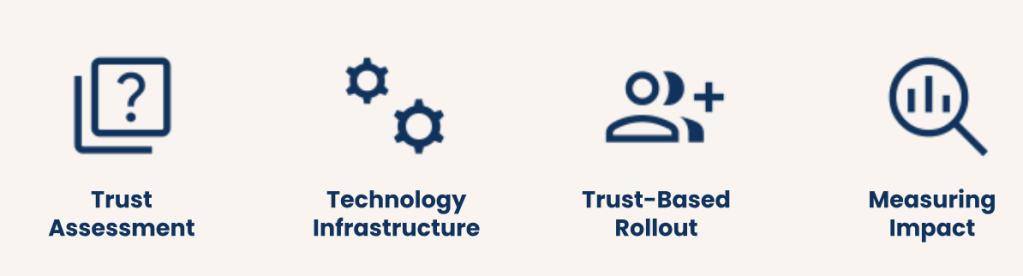
Phase 1: Trust Assessment
Before implementing new systems, organisations must understand their current trust landscape:
- Conduct anonymous trust surveys using validated metrics like the Leadership Trust Index (LTI)
- Map existing informal support networks
- Identify key barriers to mental health disclosure
- Assess current data protection and privacy mechanisms
- Benchmark current trust levels against industry standards
Phase 2: Technology Infrastructure
Select and implement technology solutions that enable:
- Granular privacy controls that put employees in control
- Anonymous aggregation of mental health data
- Secure data storage and transmission
- Integration with existing wellbeing initiatives
- Seamless connection with daily workflow tools like Slack and Microsoft Teams
- Single sign-on to reduce platform fatigue
Phase 3: Trust-Based Rollout
Implement changes gradually to build confidence:
- Start with pilot groups who can champion the approach
- Demonstrate privacy protections in action
- Show clear examples of how aggregate data informs decisions
- Build feedback loops for continuous improvement
- Implement recognition programmes that reward participation with additional wellbeing days
- Create positive feedback loops between engagement and rewards
Phase 4: Measuring Impact
Establish clear metrics for success:
- Engagement rates with mental health support
- Reduction in absenteeism and presenteeism
- Employee trust scores
- Business impact of data-informed decisions
- Overall team performance improvements
Conclusion
The trust gap in workplace mental health support represents both a challenge and an opportunity. While organisations have demonstrated their commitment through increased investment, the path to effective support lies not in spending more, but in building better trust architecture. By implementing the framework outlined in this paper, organisations can create an environment where employees feel safe sharing mental health information, leading to better individual outcomes and stronger organisational performance.
The benefits extend far beyond mental health support alone. As organisations build trust architecture, they create the foundation for high-performing teams, better change management, and more resilient workplaces. In today’s rapidly evolving business environment, this trust-based approach isn’t just about supporting mental health—it’s about creating the conditions for sustainable organisational success.
How Duck Score Enables Trust Architecture
Traditional workplace mental health solutions often suffer from low engagement due to trust and privacy concerns. Duck Score is designed to bridge this gap by providing a safe, simple, and privacy-controlled way for employees to engage with their mental wellbeing without fear of career consequences.
Granular Privacy Controls
- Employees can self-assess their mental wellbeing through a 1-5 scoring system, with optional private journaling
- Control over sharing: Employees choose whether to keep scores private, share within a trusted nest (small support group), or contribute anonymously to organisational wellbeing trends
Separation from Performance Reviews
- Duck Score operates independently from HR and performance evaluations
- Employees engage voluntarily, without risk of managerial oversight or judgement
Evidence of Impact: Data-Driven Wellbeing Insights
- Organisations receive aggregated, anonymised insights to understand trends without compromising individual privacy
- Provides leading indicators of wellbeing, helping employers make proactive adjustments to workplace culture and support systems
Flexible Implementation for Any Workplace
- Available as a standalone employee wellbeing tool or as an enterprise integration (e.g., Slack, Microsoft Teams)
- Supports organisations in monitoring the effectiveness of mental health initiatives through real-time, ethical data tracking
By embedding trust into workplace mental health initiatives, Duck Score transforms how organisations support employee wellbeing—without compromising individual autonomy.
Appendices
Full Survey Results
The survey engaged over 500 professionals from diverse industries and organisational hierarchies. Key demographic details include representation across technology, healthcare, finance, and manufacturing sectors. Respondents ranged from individual contributors to C-suite executives, ensuring a comprehensive understanding of workplace mental health dynamics.
Methodology Details
Duck Score conducted an anonymised online survey between January 1 and January 15, 2025. The questionnaire consisted of both quantitative and qualitative sections, exploring attitudes, concerns, and preferences regarding workplace mental health support. Data was analysed using descriptive statistics and thematic coding to uncover trends and insights.
References
- BBC News (2024). “Investigation into EAPs: how the industry has reacted.” BBC Radio 4, 15 March 2024.
- Deloitte (2024). “Mental health and employers: The case for investment – pandemic and beyond.” Deloitte UK, March 2024.
- Deloitte (2022). “Mental Health and Employers Report.” Deloitte UK.
- Duck Score (2025). “Trust in the Workplace: Mental Health Support Survey.” Survey of 500 professionals across UK, US, and Europe, January 2025.
- Forbes (2024). “Leadership Trust Index: Quantifying Trust in Organizations.” Forbes Business Review.
- Harvard Business Review (2024). “The Impact of Trust on Organizational Performance: A Quantitative Analysis.”
- Journal of Occupational Health Psychology (2024). “Predictors of Engagement in Workplace Mental Health Initiatives.”
- McKinsey & Company (2024). “Psychological Safety as a Driver of Performance.”
- Mind (2023). “Mental Health and Wellbeing Survey.”
- MIT Sloan Management Review (2024). “Innovations in Employee Wellbeing Programs.”
- REBA (2024). “Inside track: Is your EAP delivering for your workforce?”
- World Health Organisation (2024). “Economic Impact of Workplace Mental Health Issues.”
About Duck Score
Duck Score is a newly emerging company dedicated to transforming workplace mental health through innovation and evidence-based solutions. Our mission is to empower businesses with tools and strategies that foster trust, privacy, and psychological safety.
As a small but dynamic team of experts—including technology industry veterans Emma Mulqueeny and Mark Dando, psychiatrists and neuroscientists, data scientists, graphic designers, and developers — we bring diverse perspectives and skills to solve this critical issue. Our app, already live, captures data, generates insights, and facilitates small trusted groups, providing organisations with actionable frameworks to enhance employee well-being.
With this white paper, we aim to collaborate with forward-thinking organisations in piloting our solutions and testing hypotheses that address the pressing trust gap in workplace mental health. Join us in shaping the future of workplace well-being.


 Duck Score