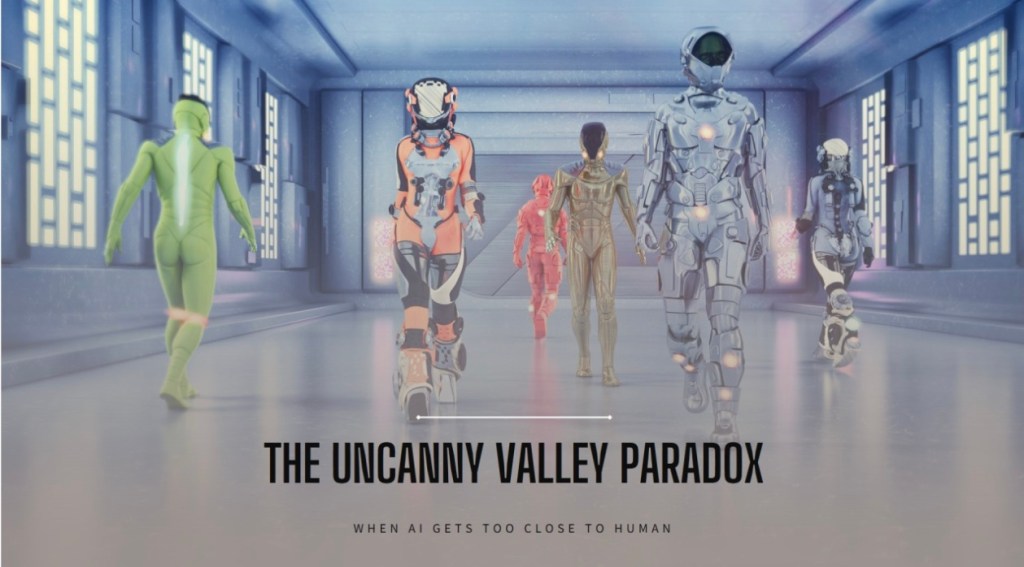
Something strange is happening in our relationship with AI. Roboticist Masahiro Mori described it back in 1970 as the ‘uncanny valley’ – that unsettling feeling when something appears almost, but not quite, human. Think of ultra-realistic CGI characters whose slight imperfections make them more disturbing than cartoons. As AI becomes more sophisticated, you might expect this effect to disappear. Yet something unexpected is happening: our sensitivity to artificial humanity seems to be increasing.
I first encountered this concept in Barcelona back in 2016. I was invited to do some work with Oliver Harrison, MD MPH on a health moonshot at Telefonica, trying to imagine what the future of healthcare might look like. Mental health emerged as our greatest challenge, but we couldn’t have predicted how AI would transform this landscape.
A personal tragedy during that time drove home the desperate need for better mental health support. It wasn’t just about accessibility anymore – it was about creating solutions that could genuinely help people while feeling authentic and trustworthy.
Fast forward to today, and recent research reveals something fascinating. Studies from early 2024 show that even as we casually chat with ChatGPT and let AI help write our emails, we’re becoming more, not less, sensitive to artificial attempts at human connection. AI news anchors still trigger feelings of eeriness, while AI-generated forecasts face persistent skepticism compared to human predictions.
This creates a fascinating tension in mental health technology. How do we harness AI’s remarkable capability for pattern recognition and insight generation without triggering that uncanny valley response? The answer might lie in not trying to make AI more human-like at all.
Through our work at Duck Score, we’re discovering that technology works best when it knows its role. AI excels at spotting patterns and generating insights from data – things the human brain isn’t optimised for. Meanwhile, real human connection happens best in small, trusted groups where people can be their authentic selves. It’s about creating distinct spaces where each can play to its strengths.
It’s like we’ve been trying to teach fish to climb trees when they could be showing us new ways to swim. The real opportunity isn’t in making AI more human-like, but in using it to enhance genuine human connections. Perhaps the uncanny valley isn’t an obstacle to overcome, but a guide showing us where to draw the line between artificial and human interaction.
Think about a therapist’s office. The value isn’t just in the therapist’s insights, but in the human connection – the empathy, understanding, and trust built over time. Similarly, our closest relationships aren’t built on pattern recognition or data analysis, but on shared experiences and emotional bonds. What if technology could support both these elements without trying to replicate them?
This shift in thinking has profound implications. Instead of asking “How do we make AI feel more human?”, we should be asking “How do we use AI to support and enhance human connection?” It’s about creating digital spaces where AI can provide valuable insights while preserving authentic human interaction.
Looking back at those early discussions in Barcelona, I realise we were asking the wrong questions. The future of digital mental health support doesn’t lie in crossing the uncanny valley, but in building bridges over it – creating environments where AI and human interaction each serve their distinct purpose in supporting mental wellbeing.
The uncanny valley might just be showing us the way forward – not by trying to make technology more human, but by letting it be brilliantly, unashamedly artificial in service of genuine human connection.
 Duck Score